

All you need to know to make the most of your revenue management software
Maximising revenue is the goal of every hotel, and never more so than at a time when visitor budgets are being squeezed and business costs are rising. Revenue management is far more of a science than an art, and is characterised by metrics, KPIs and formulae that every hotel manager should be aware of.
To successfully manage a hotel, owners and business leaders need to be able to anticipate how demand will change and then optimize their pricing strategy accordingly. This is where revenue management comes in because it allows you to use data and analytics to predict consumer behaviour according to factors such as demand, pricing, seasonality and location, and make necessary adjustments.
Hoteliers can use a range of different key performance indicators (KPIs) to arrive at a well grounded overview of their property’s revenue potential, and can of course integrate with APIs such as RoomPriceGenie to set algorithms based on your maximum and minimum pricing for both peak and low periods which then runs itself.
“There are several KPIs which capture specific revenue points within a hotel”
“There are several KPIs which capture specific revenue points within a hotel,” said Sarah Cade, MD at Rezcontrol. “In this blog, we will discuss these revenue formulas and how they contribute to the wider picture of a hotel’s financial performance, so you can set your parameters accordingly to maximise revenue, occupancy, or both – as well as looking at some wider strategies you can employ to boost your margins beyond the usual calculations.”
These are broken down into four parts – the basics, the long term elements, the F&B and the ‘big picture with the little extras’ – which make a big difference.
PART 1: The Basics
First of all, you need to know your Average Daily Rate, or ADR. This can vary greatly between hotels according to whether their market segments are tourism or corporate, as well as being influenced by seasonality and location, but this is a vital starting point to help you set your highest and lowest revenue expectations, in order to define a strategy and understand your margin potential and budgetary constraints. The calculation is simple:
Total room revenue
Number of rooms sold
Ways to increase your ADR include offering ‘freebies’ – such as including a spa pass – or incentivising extended stays. These can bump up your ADR by several percent, adding to your bottom line for little increase in outlay.
- Occupancy Rate. This, quite simply, is the percentage of rooms sold at any one time. So if on average you have 34 rooms of which 28 have been booked, your occupancy rate is 82%.
Number of rooms booked
Total number of rooms
This can be boosted by creating offers at slow times – however you need to ensure you are not denting your profitability in the interests of high occupancy rates.
- Revenue per Available Room (RevPAR). This revenue formula is one of the most important KPIs in hotel revenue management. It differs from ADR in that it indicates how much money a hotel has made per available room, instead of just the ones that are occupied by guests.
“RevPAR paints a bigger picture of your hotel revenue than either occupancy rate or ADR could do alone.”
For example, a hotel’s average daily rate may be on target, but if its occupancy rate is only at 40%, it’s probably not bringing in enough revenue to cover its operational costs. As a combined metric, revPAR can tell you these things.
Total Room Revenue
Total Available Rooms
or
Average Daily Rate x Occupancy Rate
Taking measures to increase both your ADR and occupancy rate, as outlined above, will improve your revenue per available room – in turn improving the overall health of your business.
PART 2: In it for the long term
- Average length of stay (ALOS) – this is an important measure, which we referred to earlier in the context of encouraging longer stays. The longer a room is occupied by a single booking, the less the resulting cost for that stay as it reduces labour cost.
Total occupied rooms
Total number of bookings
- Guest Lifetime Value (LTV). Often overlooked, this is a more sophisticated, revenue-centric way of measuring return guests. These guests have a higher average spend and are more likely to purchase upsells. It also costs much less to reconvert previous guests than to acquire new ones. In other words, focusing on guest loyalty is a surefire way to boost revenue. The higher your LTV, the healthier your business.
PART 3: Don’t forget the contribution from F&B
Upsells and extras are a major part of all hospitality businesses, and a large part of these come from food and drink. Whether you are offering to upgrade meal packages, or indeed using room and restaurant deals as part of your strategy to extend stays or entice visitors at quiet times, your bar and restaurant are a vital part of your overall revenue management plan. Items four and five therefore relate directly to the contribution made by your restaurant – which may also include walk-in visitors.
- RevPASH – the revenue available per seat hour. This is another simple calculation, where you will look at:
Total Restaurant Revenue
Number of seats x Hours
The benefits of understanding your RevPASH are two-fold – you will be able to see at a glance your restaurant’s most profitable hours, and pinpoint when the restaurant is missing out. This can be used to inform adjustments to prices or service hours accordingly, while offers and discounts can increase traffic at quiet times, and upsells (such as pairing a particular wine with a dish) can increase revenue at the busiest times.
- And finally in this KPI section – TrevPAR, or total revenue (including upsells, extras, golf and spa offerings, meal packages and bar/restaurant sales) per available room. While revPAR only focuses on revenue drawn from accommodation, TrevPAR incorporates your hotel’s entire net revenue. That includes revenue from rooms, the restaurant and any other amenities your property offers.
The total calculation is, yet again, simple – the complexity is in how you put all the elements together to work out the most attractive, and profitable, overall propositions in your pricing and revenue strategy.
Total revenue
Total available rooms
The most effective way to approach this is probably to understand each individual element, and cross check it against the TrevPAR, which will be the final arbiter of how your hotel is doing. But it is vital to understand each element, as this is where small tweaks can generate large dividends.
Pitch your revenue calculations against your operating costs
The final stage calculations stage is to match your revenue data against your operating costs, by pitting revenue against cost with Gross Operating Profit Per Available Room or GOPPAR – revenue minus operating expenses divided by number of rooms; as well as your market penetration index (MPI) which reflects your occupancy rates versus those of your competitors.
PART 4: ‘The big picture with the little extras’ – small tweaks which can generate large dividends
Most hoteliers will be aware of the formulae, and will be using some or all of them, together or separately. Many hotels also already market their event spaces, whether for weddings, funerals or conferences, to a wider public beyond their resident guests – for many this is a specialism.
You will also no doubt be promoting a wide range of little offers and upsells during the course of a guest’s stay, as well as encouraging goodwill afterwards by inviting reviews while making return visitor offers, perhaps via a loyalty program such as Inspire Loyalty. But there’s more…
Profit from parking, office and fitness spaces
In some areas, small, almost invisible, adjustments can make a big difference to the bottom line. If you don’t already, increase your offering to non-residents via the revenue potential which can be gained from parking, co-working or virtual office spaces, meetings and wellness facilities. Gyms and pools can be opened up to external memberships, while if you have office space available this can double as an option to work away from home, or host a meeting.
Make payments frictionless
The easier it is for a guest or visitor to pay, the more they are likely to purchase. Payment automation will also reduce fraud and chargebacks, so it’s a win-win.
Segment audience by booking origin
Another trick which goes beyond the standard metrics is to really understand where your guests and visitors have come from, in terms of how they found you. You can then calculate the cost of acquisition, as well as the revenue per source.
Guest acquisition cost (GAC – also called customer acquisition cost, or CAC) usually makes up 15-25% of overall room revenue. These costs include commissions through OTAs, transaction fees, marketing spend and loyalty programmes.
Once you have this information to hand, integrations such as FOR-Sight CRM can be used to deliver segment-based CRM-driven marketing to different customer groups.
Know the competition
Sun Tzu, a military general, philosopher, strategist and writer from the Eastern Zhou period (771 to 256 BCE), is credited with saying “Keep your friends close; keep your enemies closer.” Therefore, get to know your competitors – there is more data available than you may think. Research your competitors with online tools such as STR reports, OTA websites and review platforms – you want to be looking for occupancy, ADR, RevPAR, ARI, MPI and RGI.
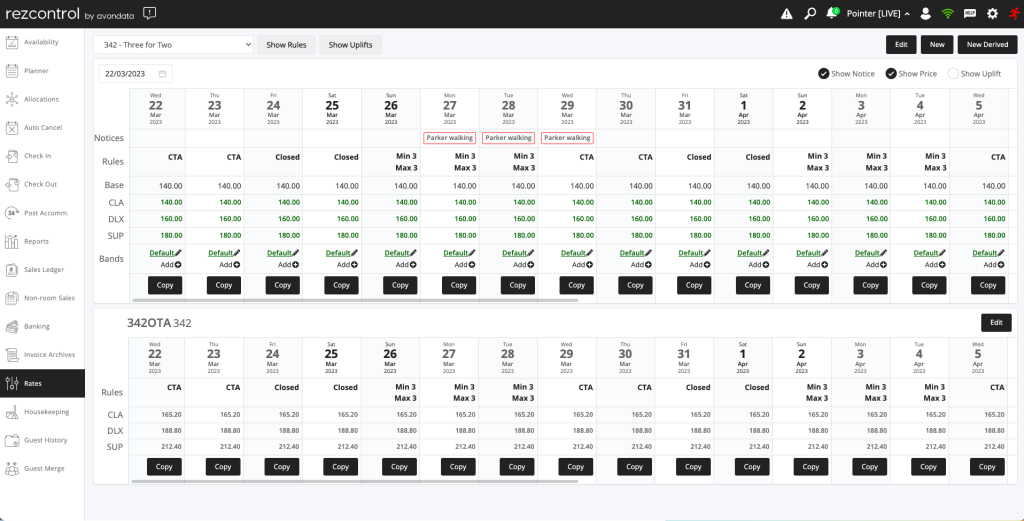
To help you manage and predict your revenue, with features such as PACE reporting and automated pricing, Rezcontrol incorporates a sophisticated, automated rate management system as well as integrating with powerful partners which all combine to increase your revenue – whether they are channel managers such as SiteMinder or revenue management specialists like RoomPriceGenie – as well as others which will boost your events and ticketing, gift voucher sales, table reservations and more.
We have also launched a new Rezcontrol booking engine, designed to make it ever easier for your guests to book direct, adding all their requirements into one basket, with one easy checkout and a single confirmation – with the ultimate goal of driving revenue for you, while making your guest experience seamless.
Not a customer? Call us on +44 (0)330 223 1456 or email sales@rezcontrol.com – you can also book a chat or contact us for a demo.